
The Science of Pretreatment in Electroplating: How Proper Cleaning, Activation, and Rinsing Build the Foundation for High-Quality Plating
In electroplating operations, the same situation repeats itself across production floors on a regular basis. A rejected component—showing defects such as blistering, poor adhesion, skip areas, or surface haze—is examined, and attention is immediately directed toward the plating bath. The assumption is almost automatic: the brightener is ineffective, the additive balance has shifted, or the bath chemistry is out of control.
Yet decades of on-site troubleshooting and process evaluation consistently point to a different conclusion: the plating bath is rarely the primary cause of failure.
The formation of a sound, adherent metallic coating does not begin inside the plating tank. It is determined much earlier, within the pretreatment stages, before the component is exposed to electrical current. Unless the substrate surface is chemically clean, oxide-free, and electrochemically active at a microscopic level, stable metal deposition cannot occur.
Any residual oils, polishing compounds, oxides, or passive films create an invisible barrier that disrupts ionic transfer and electron flow. Under such conditions, even the most advanced proprietary additives or precisely controlled plating formulations cannot compensate for inadequate surface preparation.
At Progressive Surface Systems, we advocate moving beyond this reactive approach. Surface cleaning is not a preliminary step; it is the controlling factor that governs plating quality, consistency, and long-term performance, and understanding it correctly is the key to achieving reliable finishes.
The Science of ‘Clean’: Why Visual Inspection Fails
In our daily lives, “clean” simply means no visible dirt.
In electroplating, “clean” is a strict scientific standard that your eyes cannot see.
For a metal ion to bond securely to a substrate, it requires direct, atomic-level contact.
Even a microscopic layer of oil, oxide, or soil acts as a dielectric barrier.
This invisible barrier prevents the ionic transfer required for adhesion.
The Hydrophilic Test (Water-Break Test)
We aren’t just looking for a surface that looks shiny — we are looking for a surface that is hydrophilic (water-loving).
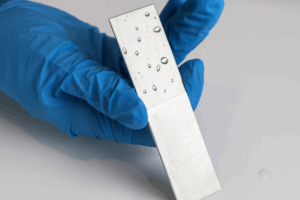
When you rinse a part, the water should sheet off efficiently in a continuous film.
If you see water beading up (the “water-break” test), oils are still present.
If you plate over this, the finish will fail — often as blistering or peeling 24 to 72 hours later.
Surface Chemistry Behind Adhesion
Electroplating adhesion is fundamentally governed by electrochemical and interfacial phenomena occurring at the metal electrolyte boundary. When a metal substrate is immersed in a plating solution, ions from the electrolyte must migrate toward the cathodic surface and undergo reduction to form a metallic deposit.
For this reduction reaction to occur efficiently, the substrate surface must remain electrically conductive and chemically active. Any insulating contamination—such as organic residues, polishing binders, or oxide layers interrupts electron transfer and interferes with the nucleation of the plated metal.
In practical terms, the initial stage of electroplating involves the formation of microscopic nucleation sites where the deposited metal begins to grow. If the surface is uniformly clean and activated, nucleation occurs evenly across the substrate, producing a smooth, adherent deposit.
However, when contaminants remain on the surface, nucleation becomes uneven. Some areas receive plating while others remain inactive, leading to defects such as skip plating, roughness, blistering, or localized peeling. Understanding this electrochemical interaction reinforces why effective pretreatment is essential to achieving consistent plating performance.
One Size Does Not Fit All — Why Cleaning Must Be Customized
A common mistake we see in struggling plating shops is using a “universal” cleaning line for every metal.
This is a recipe for rejection because different substrates have different chemical sensitivities.
1. Zinc Die Cast (Zamak)
Zamak is highly porous and chemically sensitive.
If you use a cleaner that is too aggressive (high alkalinity or temperature), you will etch the surface deeply, opening up sub-surface porosity.
This leads to “blind holes” that trap chemicals and bleed out later, ruining the finish.
The Fix: Use mild, inhibited alkaline soak cleaners and controlled activation steps designed to preserve the surface profile.
2. Brass and Copper
These soft metals often come with heavy polishing compounds and buffing waxes.
The challenge here is removing the binder in the wax without tarnishing the high-gloss polish.
The Fix: A robust soak cleaner with excellent emulsification properties is key, followed by a light electro-clean to lift the last of the compound from recesses.
3. Steel and Iron
Steel is prone to rapid oxidation (flash rust) and often carries heavy machining oils.
The Fix:
You can afford to be aggressive here — high-caustic soak cleaners and strong anodic (reverse) electrolytic cleaners are essential to scrub the surface and remove smut.

Role of Surface Oxides in Plating Failures
Metal surfaces naturally react with oxygen in the atmosphere to form oxide layers. These oxides are often extremely thin sometimes only a few nanometers thick but they significantly affect electroplating performance.
For example, steel surfaces may form iron oxide films, while copper and brass surfaces develop copper oxide or copper sulfide layers. These oxide films are chemically stable and can inhibit direct metal-to-metal bonding during plating.
Acid activation or pickling stages are therefore critical in removing these oxide layers. Acids dissolve surface oxides and expose the underlying metallic lattice, allowing the plating deposit to bond directly with the substrate.
If oxide removal is incomplete, the plating deposit may adhere temporarily but eventually fail during service. This failure typically appears as blistering or flaking when the plated component experiences mechanical stress or environmental exposure.
Effective activation ensures that the surface remains electrochemically receptive to metal deposition at the moment it enters the plating bath.
The Multi-Stage Defense Against Defects
A single dip in a degreaser is never enough.
A world-class pre-treatment line at Progressive Surface Systems typically follows a rigorous sequence:
- Soak Cleaning:
The heavy lifter. This stage saponifies vegetable oils and emulsifies mineral oils, removing the bulk of the soil. - Electro-Cleaning:
The precision scrubber. By using the workpiece as an electrode, we generate gas bubbles (oxygen or hydrogen) directly at the metal surface. These bubbles act like thousands of tiny scrubbing brushes, blasting away microscopic debris that a soak cleaner can’t touch. - Acid Activation/Pickling:
The final handshake. This step removes oxides and scales, exposing the raw crystal structure of the metal so it is hungry to accept the plating deposit. (See our full range of Metal Pretreatment Chemicals).
Importance of Rinse Water Quality
Rinse water quality is often underestimated in plating operations, yet it plays a vital role in maintaining process stability. Water used in rinsing stages must be free from excessive dissolved solids, oils, and suspended contaminants.
If rinse water contains high levels of hardness salts, dissolved metals, or organic impurities, these contaminants may redeposit onto the component surface. This redeposition can interfere with plating adhesion and contribute to staining or uneven deposits.
Many advanced plating facilities therefore employ treated water systems such as reverse osmosis (RO) or deionized (DI) water for critical rinse stages. These systems reduce ionic contamination and help maintain a clean surface between process tanks.
Maintaining proper rinse tank overflow rates and regular monitoring of conductivity levels also helps ensure that drag-in contamination remains under control. Properly managed rinsing systems significantly improve process reliability and reduce chemical carryover between stages.
The Hidden Cost of Poor Rinsing
If cleaning is the heart of the line, rinsing is the bloodstream.
You can have the perfect cleaner, but if your rinse tanks are saturated with drag-in (chemicals carried over from previous tanks), you are simply re-depositing contaminants onto the part.
Poor rinsing leads to:
- Drag-in contamination
- Shortened bath life
- Higher chemical consumption
- Increased effluent treatment cost
- Staining and poor adhesion
Process Consistency and Production Efficiency
Beyond defect prevention, a well-designed pretreatment line significantly improves production efficiency. When cleaning stages operate consistently, plating baths remain stable for longer periods and require fewer corrective additions.
Stable bath chemistry translates into predictable plating thickness, better appearance, and reduced rejection rates. Production lines that prioritize pretreatment quality often experience lower scrap levels and improved throughput.
In addition, effective pretreatment reduces the frequency of bath purification, filtration maintenance, and chemical replacement. This not only lowers operational costs but also improves environmental compliance by reducing wastewater treatment loads.
For plating facilities operating in high-volume manufacturing environments, optimizing pretreatment chemistry and rinsing efficiency can provide measurable improvements in both productivity and cost control.
Building a Foundation for Perfection
When a surface is:
- Chemically pure
- Electrically active
- Uniform
Even a standard plating bath will perform brilliantly.
When the surface is compromised, even the most advanced chemistry will fail.
At Progressive Surface Systems, we don’t just supply chemicals; we solve process problems.
Whether your issues are haziness, blistering, or inconsistent adhesion, the solution almost always begins with a better cleaning cycle.
Ready to Improve Your Pretreatment Line?
Is your pre-treatment line optimized for your specific substrate?
Stop guessing and start plating with confidence.
Contact the PSSPL technical team today for a line audit and discover the difference a perfect foundation makes.