
How Are Sustainable Surface Finishing Processes Changing PCB Manufacturing?
The global PCB manufacturing industry is under pressure from two directions at once: the demand for higher-performance boards on one side, and tightening environmental regulations on the other. For years, electronics manufacturers operated on the assumption that performance and sustainability were competing priorities. That assumption is no longer tenable, and in practice, it was never accurate.
The surface finishing stage, where copper pads are protected against oxidation and prepared for soldering, has historically been one of the most chemically intensive parts of the PCB process. Lead-based soldering, cyanide gold baths, and hexavalent chromium were industry norms. Today, driven by RoHS compliance requirements, customer ESG expectations, and the commercial logic of reducing waste, the industry is transitioning to cleaner, more efficient chemistries and processes. This article examines how that transition is happening and what it means in practice for manufacturers.
What Is a PCB and Why Does the Surface Finish Matter?
A printed circuit board is the structural and electrical foundation of virtually every electronic device. Copper tracks on the board carry signals and power between components, but bare copper is highly reactive; it oxidises rapidly on exposure to air, and an oxidised pad cannot be soldered reliably. The surface finish is the chemical layer applied over the copper to prevent this, preserve solderability during storage, and provide a reliable interface for component assembly.
Choosing the wrong surface finish does not just risk a failed solder joint. It affects the board’s long-term reliability, its compliance with international standards, and increasingly, the manufacturer’s ability to supply to OEMs with strict environmental procurement requirements. The surface finish decision is therefore both a technical and a commercial one.
RoHS Compliance: The Regulation That Changed PCB Manufacturing
The single most significant catalyst for sustainable change in PCB manufacturing has been RoHS, the Restriction of Hazardous Substances directive. Originally a European regulation, RoHS has become the de facto global standard for electronics manufacturing, restricting the use of ten hazardous materials, including lead, mercury, cadmium, and hexavalent chromium.
In practice, RoHS compliance effectively ended the use of leaded HASL (Hot Air Solder Levelling) as the default PCB surface finish. Lead-HASL was cheap and reliable, but its use of lead in the solder alloy made it non-compliant. Manufacturers were forced to find alternatives, and in doing so, many discovered that the alternatives were technically superior as well as cleaner.
| RoHS restricts: lead, mercury, cadmium, hexavalent chromium, PBB, PBDE, and four phthalates. Non-compliance bars manufacturers from supplying to the EU market and most major global OEMs. |
Comparing PCB Surface Finishes: Sustainability and Performance
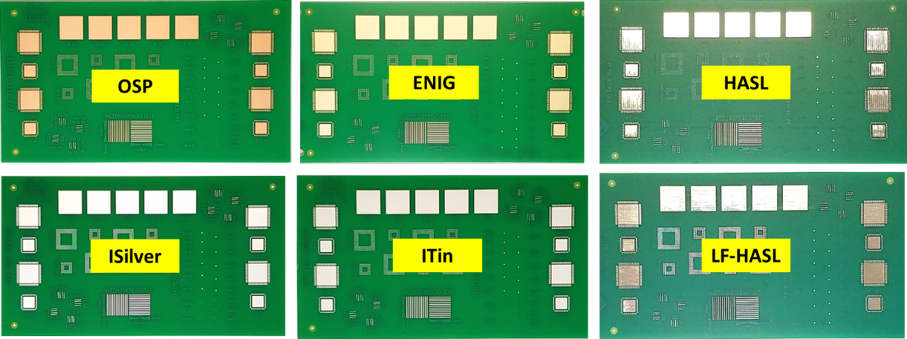
There is no single “green” surface finish. Each option involves trade-offs between chemical intensity, performance, cost, shelf life, and environmental impact. The table below summarises the most common finishes in use today.
.
| Finish | RoHS Status | Environmental Profile | Best For |
| OSP (Organic Solderability Preservative) | Compliant | Lowest impact — water-based, minimal chemistry | High-volume SMT, short shelf life acceptable |
| Lead-Free HASL (LF-HASL) | Compliant | Higher energy use than OSP, no lead | General purpose, robust, low-cost |
| ENIG (Electroless Ni Immersion Gold) | Compliant | Gold has mining impact; moving to recycled sources | HDI, fine-pitch SMT, longer shelf life |
| ENEPIG | Compliant | Chemically intensive but long-lasting | Wire bonding, high-reliability aerospace/medical |
| Immersion Silver (ISilver) | Compliant | No nickel or gold; recyclable | High-speed signal integrity applications |
| Immersion Tin (ITin) | Compliant | Lead-free and recyclable, storage-sensitive | Fine-pitch, flat surface requirements |
| Lead HASL | Non-Compliant | Contains lead — restricted globally | Legacy only; avoid for new designs |
OSP: The Greenest Finish
Organic Solderability Preservative is widely considered the most sustainable PCB surface finish currently available. It is water-based, requires significantly less energy to apply than metallic finishes, and introduces minimal chemistry into the manufacturing process. Its limitation is shelf life: OSP boards are more sensitive to handling and have a shorter window between manufacture and assembly than metallic finishes. For high-volume, fast-turn operations where boards move quickly into assembly, OSP is an excellent and sustainable choice.
ENIG: The Performance Standard
ENIG remains the preferred finish for high-density interconnect boards, fine-pitch components, and applications requiring longer shelf life or higher soldering reliability. The gold deposit protects the nickel surface from oxidation and provides a flat, co-planar surface ideal for SMT assembly. The environmental consideration with ENIG is the gold itself — gold mining carries a significant environmental cost. The industry is addressing this through the use of recycled and conflict-free gold sources, which maintain technical performance while reducing the upstream environmental impact.
Immersion Silver and Immersion Tin
Both ISilver and ITin offer RoHS-compliant, nickel-free alternatives that provide flat, solderable surfaces at lower cost than ENIG. ISilver in particular is gaining traction in high-speed digital and RF applications because it provides excellent signal integrity with minimal signal loss. Both finishes require careful storage to prevent tarnishing and oxidation, but in well-managed environments they are reliable and cost-effective sustainable options.
Sustainable PCB Processes Beyond the Surface Finish
Sustainability in PCB manufacturing extends well beyond the choice of surface finish. Manufacturers that take a whole-process view find significantly more opportunity to reduce waste, energy, and chemical consumption.
Closed-Loop Chemical Systems
One of the highest-impact changes a PCB facility can make is moving to closed-loop chemical management, where process chemistry is captured, filtered, and reused rather than discharged after a single pass. This reduces both chemical consumption and the volume of effluent requiring treatment, lowering costs and environmental impact simultaneously.
Minimising Chemical Drag-Out
Drag-out, the process chemistry that clings to boards as they move between tanks — is one of the most significant sources of chemical waste in a wet process PCB line. Optimised rinsing systems, board orientation, and appropriate withdrawal speeds can dramatically reduce drag-out volumes, keeping more chemistry in the process tanks and reducing the load on effluent treatment.
Energy-Efficient Plating and Curing
High-efficiency pulse rectification in electrolytic plating processes reduces energy consumption while improving deposit quality. Lower-temperature chemical formulations reduce the energy required to heat and maintain process baths. UV-curable conformal coatings eliminate the need for thermal curing ovens entirely and produce zero volatile organic compound (VOC) emissions, improving both energy efficiency and workplace air quality.
Regenerative Etching
In the etching stage, copper removed from the board is dissolved into the chemistry. In a regenerative system, this copper is recovered as a marketable byproduct rather than disposed of as hazardous waste. The recovered copper offsets waste disposal costs and provides a secondary revenue stream that partially funds the sustainability investment.
The Business Case for Sustainable PCB Manufacturing
The commercial logic for sustainable PCB manufacturing is strong and becoming stronger as global supply chains tighten environmental requirements. The business case rests on four pillars.
- Market access: Major OEMs in automotive, consumer electronics, and industrial sectors now require supplier ESG documentation and RoHS compliance as a condition of supply. Non-compliant manufacturers are excluded from these supply chains.
- Reduced disposal costs: Hazardous waste treatment and disposal is expensive. Reducing the volume and toxicity of process waste directly lowers operating costs.
- Resource recovery: Recovering precious metals and copper from rinse water and spent chemistry converts a waste cost into a revenue stream.
- Regulatory protection: Proactive compliance protects manufacturers from the cost and disruption of forced process changes when regulations tighten further.
Looking Ahead: Where PCB Manufacturing Is Going
The trajectory of sustainable PCB manufacturing points toward further reduction in process chemistry intensity, greater use of recycled and bio-based materials, and increasing automation to reduce human error and chemical exposure. Additive manufacturing approaches, where conductive material is deposited only where needed rather than etched away from a full copper layer, have the potential to eliminate the etching stage entirely, removing one of the most chemically intensive steps in the current process.
Biodegradable substrates are under development for short-life applications such as smart packaging and disposable sensors. Non-cyanide gold chemistries are replacing traditional cyanide-based gold baths in ENIG and ENEPIG processes, improving both worker safety and effluent treatability.
For manufacturers who view sustainability as a constraint, these changes represent a compliance burden. For those who view it as an engineering challenge, it represents an opportunity to reduce costs, improve process consistency, and access markets that are closed to competitors still running legacy chemistry.
Talk to Our Technical Team
Progressive Surface Systems works with PCB manufacturers to optimise surface finishing processes for both performance and sustainability. Whether you are transitioning away from legacy chemistry, evaluating surface finish options, or looking to reduce process waste, our team can help.
Get in touch: progressivesurfacesystems.com/enquiry