

Top 8 Chemical and Coating Solutions for Surface Finishing in the Fasteners Industry
Fasteners may be small, but their performance can affect the safety, durability and service life of an entire assembly. Bolts, nuts, screws and washers are exposed to moisture, chemicals, heat, friction and mechanical stress. Without suitable surface finishing, these conditions can cause corrosion, thread damage, wear or premature failure.
Selecting the right chemical solutions for fastener coating is therefore an engineering decision – not simply an aesthetic choice. The finish must suit the base metal, geometry, environment, dimensional tolerances and assembly requirements.
This guide explains eight commonly used solutions in the fasteners industry and their typical applications.
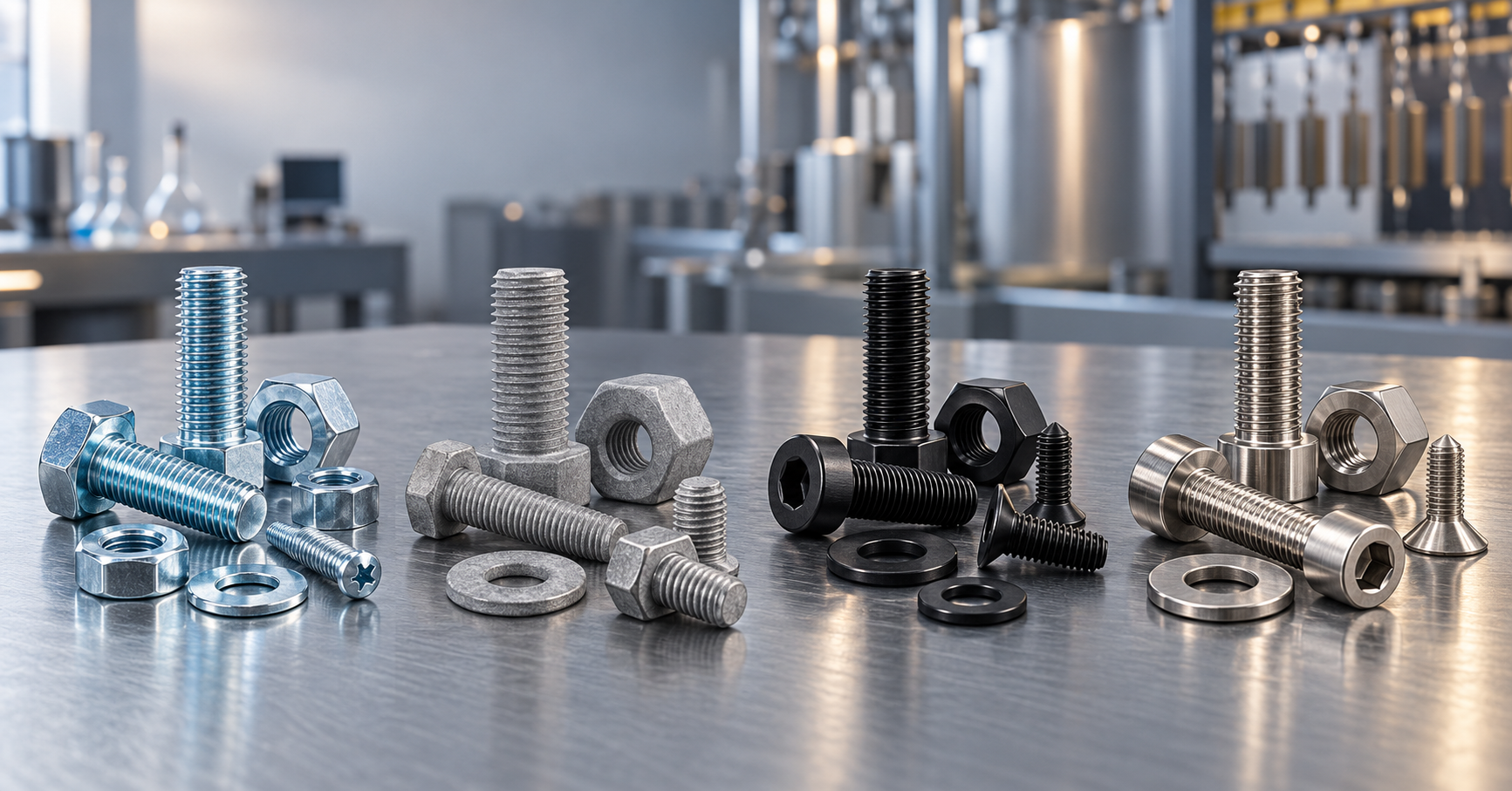
Quick answer: Zinc plating is cost-effective for many general-purpose steel fasteners. Zinc flake systems are often selected when higher corrosion resistance and a reduced risk of process-related hydrogen embrittlement are required. Stainless steel fasteners commonly use passivation, while nickel, chromium, black oxide, and phosphate serve more specialized requirements.
Why Surface Finishing Matters for Fasteners
Fasteners have threads, recesses and sharp edges that make uniform coating difficult. An effective fastener plating or coating process must protect these areas without creating buildup that interferes with thread fit.
A properly selected finish can provide:
- Corrosion protection
- Controlled friction and torque-tension performance
- Wear or chemical resistance
- Improved appearance
- Compatibility with mating materials
- A suitable base for paint, oil or another topcoat
No single finish suits every application. A coating used on an indoor screw may not be appropriate for an automotive bolt, marine fastener or stainless steel washer.
Comparison of Fastener Coating Solutions
| Solution | Main Function | Typical Applications | Key Consideration |
| Zinc plating | Sacrificial corrosion protection | General bolts, nuts, screws and washers | High-strength steel may require hydrogen-embrittlement controls |
| Zinc flake | Barrier and sacrificial protection | Automotive, energy and outdoor fasteners | Control thickness, curing and thread fit |
| Passivation | Removes free iron and supports the passive surface | Stainless steel fasteners | It is not a dimensional coating |
| Nickel plating | Wear, appearance and chemical resistance | Precision and specialized fasteners | Deposit type and thickness affect performance |
| Chromium plating | Hardness, wear resistance or appearance | Selected industrial and decorative parts | Do not confuse it with chromate passivation |
| Black oxide | Dark appearance with minimal dimensional change | Tools and indoor precision fasteners | Usually requires oil, wax or another seal |
| Phosphate coating | Lubricant or paint retention | Formed and heavy-duty components | Often used with a post-treatment |
| Cadmium plating | Lubricity and specialized corrosion performance | Restricted aerospace, defence and marine uses | Toxicity and regulations severely limit use |
1. Zinc Plating for General-Purpose Fasteners
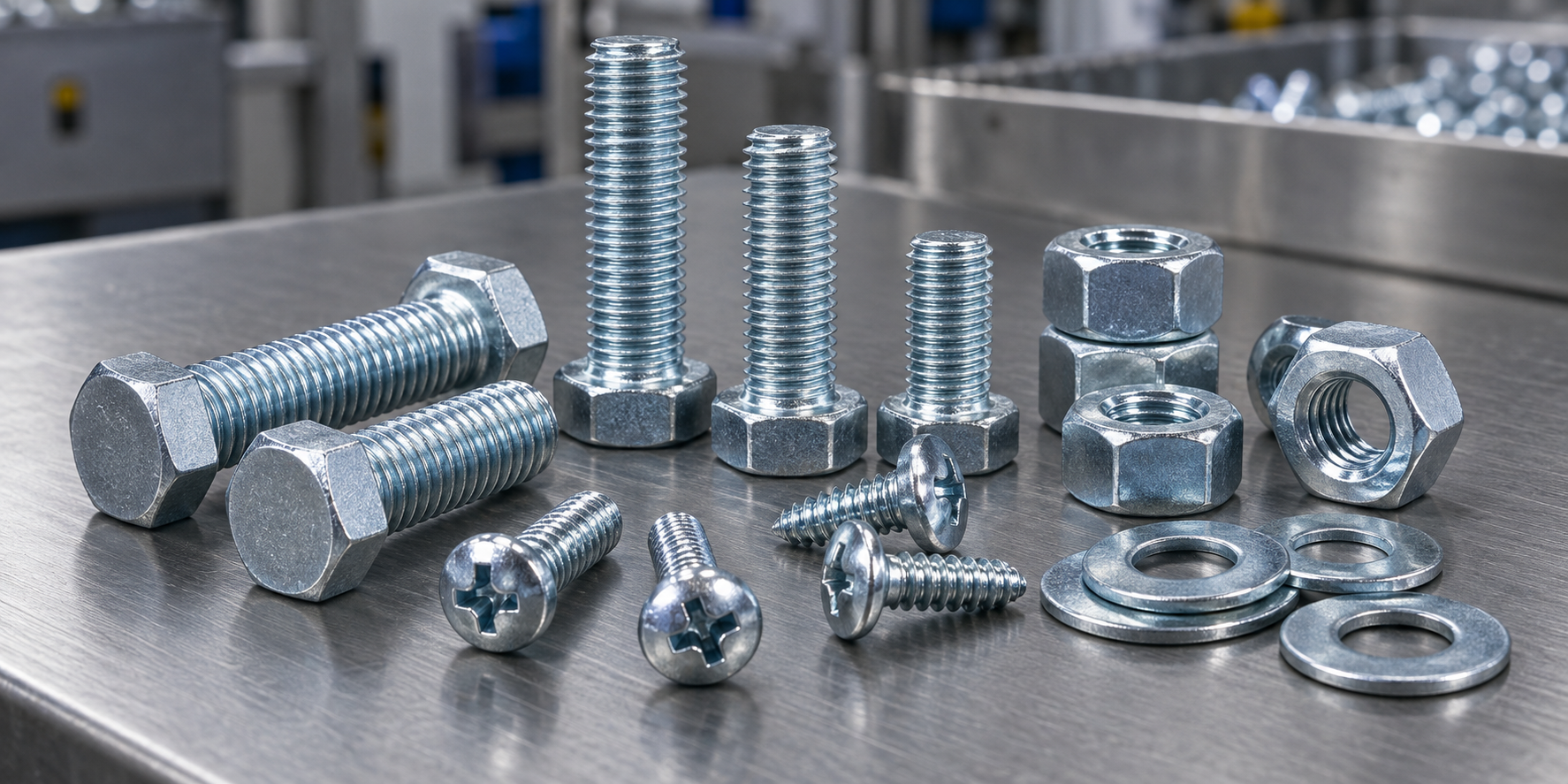
Zinc plating, sometimes searched for as “zinc plate” is an electrodeposited metallic coating used widely on carbon-steel fasteners. Zinc provides sacrificial protection by corroding before the underlying steel.
Benefits
- Cost-effective protection for many industrial uses
- Relatively thin coating suitable for threaded parts
- Compatible with specified passivation systems and sealers
- Applicable to general bolt, nut, screw and washer requirements
Important consideration
Electrocleaning, acid pickling and electroplating can introduce hydrogen into high-strength steel. If the material is susceptible, hydrogen embrittlement can cause delayed brittle failure. Material strength, preparation, baking and applicable specifications must be reviewed before processing safety-critical fasteners.
2. Zinc Flake Coatings for High-Performance Protection
Zinc flake coatings are non-electrolytic systems containing zinc and commonly aluminium flakes in an engineered binder. They are generally applied by dip-spin, spray or related methods and cured to form overlapping protective layers.
Benefits
- Strong corrosion performance at comparatively low thickness
- No electrodeposition during application, reducing process-related hydrogen charging
- Suitability for complex fastener geometries
- Topcoat options designed to influence friction
- Broad use in automotive, structural and outdoor applications
Performance depends on the complete system: pretreatment, basecoat, topcoat, curing, thickness and application method. Excess material in threads or recesses can create fit and assembly problems.
3. Passivation for Stainless Steel Fasteners
Stainless steel naturally forms a thin chromium-rich passive oxide film. Machining, forming or handling can leave free iron and other contaminants on the surface. Passivation uses a controlled treatment—commonly based on nitric or citric acid—to remove suitable contamination and support a clean passive surface.
Benefits
- Removes free iron contamination
- Supports the stainless steel’s inherent corrosion resistance
- Produces little or no meaningful dimensional change
- Suits stainless steel bolts, screws, nuts and washers
Passivation is not a deposited coating. It cannot compensate for an unsuitable steel grade, embedded scale, poor design or an environment beyond the alloy’s capability.
4. Nickel Plating for Uniformity, Wear and Appearance
Nickel may be applied through electrolytic or electroless processes. Electrolytic nickel uses electric current, while electroless nickel forms a nickel-alloy deposit through controlled chemical reduction. Electroless nickel is particularly useful where relatively uniform coverage is needed across recesses and complex shapes.
Benefits
- Wear resistance in suitable applications
- Relatively uniform electroless coverage
- Decorative and functional options
- Use on precision fasteners, hardware and selected processing equipment
Nickel is not automatically the best choice for every corrosive environment. Preparation, porosity, deposit composition, thickness and exposure conditions determine actual performance.
5. Chromium Plating and Chromate Passivation
Chromium plating deposits metallic chromium and may be used for appearance, hardness or wear resistance. Decorative chromium is generally a thin layer over an undercoat, while hard chromium is a thicker functional deposit.
Chromium plating must not be confused with chromate conversion coatings or passivation layers applied over zinc. They are different processes with different purposes.
Many suitable applications have moved toward trivalent-chromium chemistries because hexavalent chromium presents serious health and environmental concerns and is restricted in many markets. Compliance depends on the exact chemistry, application, market and applicable exemptions.
For routine corrosion protection of threaded steel fasteners, zinc-based systems are generally more common than hard chromium plating.
6. Black Oxide for Minimal Dimensional Change
Black oxide is a conversion treatment that creates a dark oxide layer. On ferrous materials, it forms magnetite at the surface. Because it modifies the surface instead of adding a substantial deposit, dimensional change is minimal.
Benefits
- Dark, low-reflective appearance
- Minimal effect on thread fit
- Suitable for tools, machinery and indoor precision fasteners
- Can retain oil, wax or another seal
Black oxide alone provides limited corrosion resistance. Actual protection normally depends on the post-treatment and service environment.
7. Zinc and Manganese Phosphate Coatings
Phosphate conversion coatings create a crystalline surface that can retain oil, soap, paint or another finishing material.
Zinc phosphate is commonly used as a paint pretreatment or lubricant carrier during forming. Manganese phosphate is associated with oil retention, wear resistance and break-in behavior on mating ferrous components.
Phosphate coatings are frequently used with a post-treatment. Their corrosion performance should therefore be evaluated as a complete coating-and-seal system.
8. Cadmium Plating for Restricted Applications
Cadmium plating offers useful lubricity, corrosion behavior and galvanic compatibility with aluminium in certain demanding environments. These properties have historically supported aerospace, defence and marine applications.
Cadmium is toxic and subject to strict environmental, occupational-health and product restrictions. It should be treated as a specialized, specification-controlled option—not a general fastener plating solution.
Depending on the requirements, alternatives may include zinc-nickel, zinc flake or another approved system. Replacing cadmium does not automatically establish RoHS, REACH or other compliance; the full process and product must be checked against applicable requirements.
Fastener Coating Applications
Bolt coating
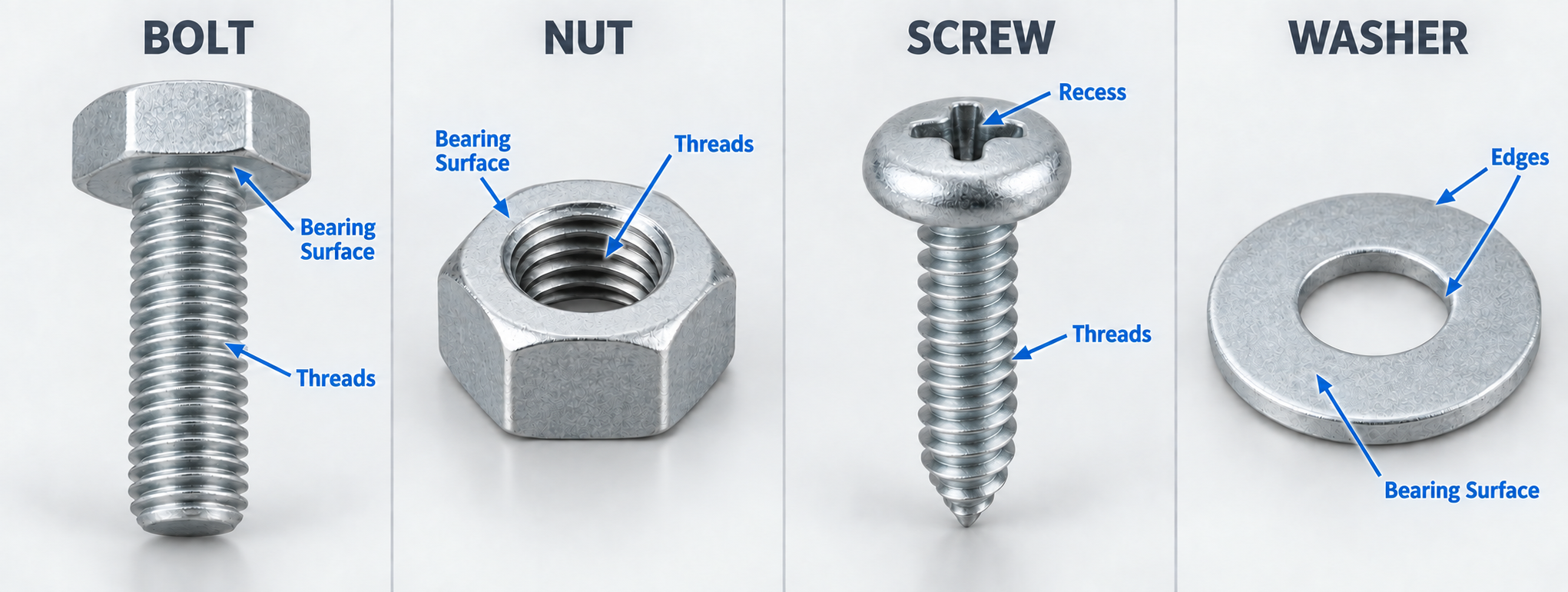
A bolt coating may need to resist corrosion while maintaining controlled friction and predictable clamp load. Thickness on threads and under-head bearing surfaces must meet dimensional and performance requirements.
Nut coating
A nut coating must cover internal threads without excessive buildup. It should be evaluated with the mating bolt because the combination can affect friction, prevailing torque and assembly.
Screw coating
A screw coating may be selected for corrosion protection, appearance or installation performance. Self-tapping and thread-forming screws can create additional coating-wear demands.
Washer coating
A washer coating must protect broad bearing surfaces and edges while remaining compatible with the bolt, nut and joined materials. Galvanic compatibility matters in mixed-metal assemblies.
For application support, explore Progressive Surface System’s fastener coating solutions
How to Select the Right Fastener Coating
- Base material: Identify carbon steel, alloy steel, stainless steel, aluminium or another substrate.
- Strength and hardness: Check whether preparation or electroplating creates a hydrogen-embrittlement risk.
- Service environment: Consider humidity, salt, chemicals, temperature and exposure.
- Corrosion requirement: Follow the product specification instead of choosing from salt-spray hours alone.
- Dimensional tolerance: Confirm the coating allowance on threads and close-fitting areas.
- Friction requirement: Evaluate torque-tension behavior, lubricants, sealers and topcoats.
- Material compatibility: Consider galvanic interactions with mating parts.
- Regulations: Verify customer, industry and destination-market requirements.
- Appearance: Define color, gloss and consistency where relevant.
- Production needs: Match rack, barrel, dip-spin, spray or other methods to geometry and volume.
Troubleshooting Common Finishing Defects
Peeling or poor adhesion
Oil, oxide, scale or inadequate activation can prevent proper bonding. Review cleaning, rinsing and activation before changing the coating chemistry.
Dull or inconsistent deposits
Bath imbalance, contamination, current-density variation, temperature or additive control can affect appearance and performance.
Thread clogging or poor fit
Excess thickness, poor drainage or unsuitable dip-spin settings can leave too much material in threads. Check coating allowance, application parameters and thread-gauge results.
Incomplete passivation
Incorrect chemistry, concentration, temperature, time or rinsing can produce inconsistent results. Verify the process against the governing specification.
Common Fastener-Finishing Standards
- ASTM B117: Practice for operating salt-spray (fog) apparatus. It defines a test environment, not a universal service-life requirement.
- ISO 4042: Requirements related to electroplated coating systems for fasteners.
- ASTM F1941/F1941M: Electrodeposited coatings on mechanical fasteners.
- ISO 10683: Requirements for non-electrolytically applied zinc flake coating systems for fasteners.
Test hours should not be treated as a direct prediction of real-world service life. The required finish, method and acceptance criteria must come from the relevant specification.
More Sustainable Surface-Finishing Choices
Manufacturers increasingly evaluate worker safety, restricted substances, energy, emissions, water and waste. Developments include:
- suitable trivalent-chromium systems replacing hexavalent-chromium processes;
- chromium-free zinc flake technologies where specifications permit;
- water-based formulations designed to reduce solvent-related emissions;
- citric-acid passivation for suitable stainless steel applications; and
- improved monitoring and recovery systems that reduce chemical and water losses.
A chemistry should not be called “green,” “non-toxic” or “compliant” without evidence. Environmental performance must be assessed across the complete process.
How Progressive Surface Systems Supports Fastener Surface Finishing
Consistent coating depends on more than chemistry. Cleaning, rinsing, temperature, filtration, agitation, handling, dosing, application and curing all influence the result.
Progressive Surface Systems (PSSPL) supports industrial surface-finishing operations with engineered equipment and process solutions developed around application requirements. Explore the Progressive Surface Systems product gallery or discuss your production needs with the Progressive Surface Systems team.
Conclusion
Choosing among zinc plating, zinc flake, passivation, nickel, chromium plating, black oxide, phosphate and cadmium requires more than comparing appearance or cost. The right chemical solutions must match the material, strength, geometry, environment, friction requirements and applicable standards.
For routine steel fasteners, zinc-based systems are common starting points. Stainless steel parts may require passivation, while nickel, chromium, black oxide and phosphate serve specialized needs. Cadmium should be reserved for controlled applications where it is expressly permitted and technically necessary.
Progressive Surface Systems can help manufacturers evaluate equipment and process requirements for consistent fastener corrosion protection across bolts, nuts, screws and washers. Contact Progressive Surface Systems to discuss your application.
Frequently Asked Questions
What is fastener coating?
Fastener coating is the application or formation of a protective or functional surface layer on bolts, nuts, screws, washers and related parts. It can improve corrosion resistance, wear, appearance, friction control or assembly compatibility.
Which coating provides the best corrosion protection for fasteners?
There is no single best option. Zinc flake and engineered zinc-alloy systems are often considered for demanding conditions, while zinc plating suits many general applications. Selection depends on the substrate, environment, tolerance and specification.
What is the difference between zinc plating and zinc flake coating?
Zinc plating is an electrolytic metallic-deposition process. Zinc flake is normally a non-electrolytic coating applied and cured as an engineered flake system. Zinc flake can provide high corrosion performance at low thickness and avoids hydrogen generation during electrodeposition, although both require correct pretreatment and control.
Can the same coating be used on bolts, nuts, screws and washers?
Sometimes, but it must be assessed for each component’s geometry and function. Internal nut threads, screw-driving surfaces, bolt bearing areas and washer edges can have different thickness, friction, drainage and wear requirements.
Does fastener coating affect thread fit and torque?
Yes. Thickness can affect thread dimensions, while the finish, sealer and lubricant can change friction and torque-tension behavior. These factors should be specified and tested as part of the complete fastener system.
Is black oxide suitable for outdoor corrosion protection?
Black oxide alone generally provides limited protection. Its performance usually depends on oil, wax or another seal, so more robust systems are normally considered for prolonged outdoor exposure.
How should manufacturers choose a fastener coating?
Review the base material, strength, exposure, corrosion requirement, dimensions, friction, mating materials, regulations and customer specifications. Testing the complete system on representative parts is preferable to selecting from a generic description.